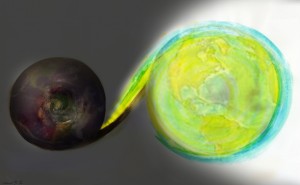
Ozin group Ph.D. student Chenxi Qian was awarded a prestigious 2nd place award in the Science as Art competition at the 2015 Fall Meeting of Materials Research Society. Congratulations CQ!
Galleries from past winners can be viewed on the MRS website
Ozin group Ph.D. student Chenxi Qian was awarded a prestigious 2nd place award in the Science as Art competition at the 2015 Fall Meeting of Materials Research Society. Congratulations CQ!
Galleries from past winners can be viewed on the MRS website
The University of Toronto Solar Fuels Cluster led by Professor Geoff Ozin has been awarded the prestigious $1M Connaught Global Challenge Award. Financed by the $105M Connaught Fund, the award is geared to funding research that addresses the grand challenges facing humanity in the 21st century. The funding support runs from Sep 2015 to Dec 2017.
More information including an interview with Prof. Ozin can be found on the U of T website
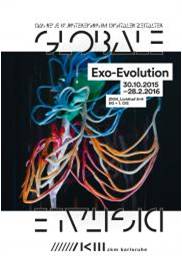
The exhibition “Exo-Evolution” presented at the ZKM Center for Art and Media in Karlsruhe, Germany, sets its focus on the artistic application of new technologies, offering views of the future and the past with its modules. With new tools and meta-tools, data and metadata, man creates a new exo-universe. By not only leaving the field of engineering culture to the sciences, art follows up to other epistemic systems, which explain and change the world. This new form of art aims for solutions like the exo-evolution itself and thus itself becomes part of the exo-evolution.
The exhibition focuses on the artistic use of new technologies and opens up views into the future, in various modules. It shows us our new reality, which is shaped by 3-D printers and robots, cyborgs and chimeras, molecules and gene pools, wearable technologies and medical miracles, synthetic life forms, bionic suits and silicon retinas, artificial tissue and repair techniques, and new discoveries in space research, molecular biology, neurology, genetics, and quantum information science.
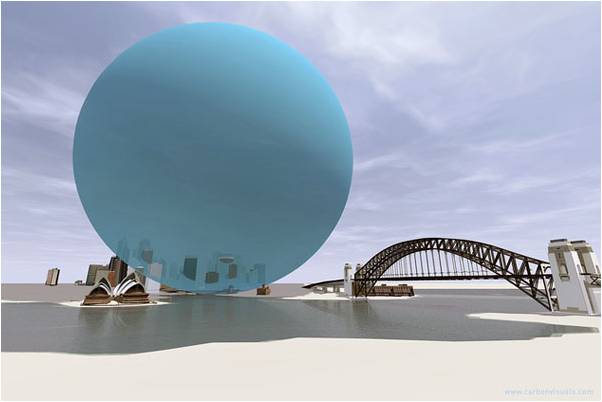
Visions and solutions for twentieth-century problems are presented, such as that under development at the University of Toronto by the Solar Fuels Research Cluster spearheaded by Professor Geoffrey Ozin. They passionately believe that CO2 should be viewed as an asset not a liability. The art-science exhibit portrays a strategy for utilizing CO2 on a global scale for making chemicals, polymers and fuels to combat the climate crisis. This strategy offers an appealing and cost-effective solution to the intertwined challenges of climate change, renewable energy and environmental pollution facing humanity today,
www.artnanoinnovations.com.More information about the exhibit can be found here
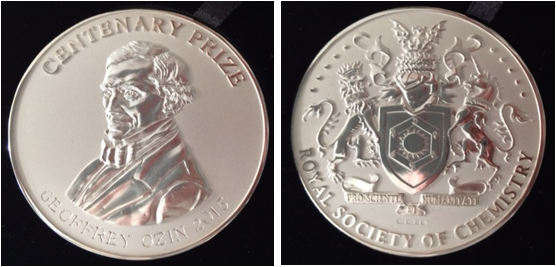
Professor Ozin was awarded the Royal Society of Chemistry’s Centenary Prize for 2015. The prize is awarded to outstanding chemists, who are also exceptional communicators, from overseas to give lectures in the British Isles. The Centenary Prize was founded in 1947 to commemorate the centenary of the Chemical Society in 1841. In 1980, the Chemical Society and the Royal Institute of Chemistry, together with the Faraday Society and the Society for Analytical Chemistry, became the Royal Society of Chemistry.
The 2015 Prize was awarded to Professor Geoffrey Ozin for his work in defining, enabling and popularising a chemical approach to nanomaterials for innovative nanotechnology in advanced materials and biomedical science. He delivered Centenary Lectures at Cambridge University and Imperial College London University on the subject of ‘Solar Powered CO2 to Fuel’ and he attended the RSC Award Ceremony that was held in Manchester Cathedral where he received a medal, certificate and monetary prize. Congratulations!
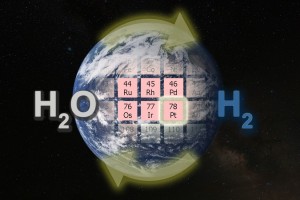
Geoff’s latest Materials Views NanoChannel opinion article has been posted online. In it, Geoff answers the question of whether platinum metal is abundant enough and economically viable to act as a co-catalyst in a potential hydrogen economy.
The full article can be found on the Materials Views website
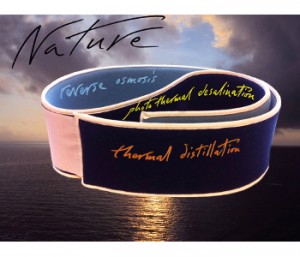
Geoff’s latest Materials Views NanoChannel opinion article has been posted online. In it, Geoff discusses a new paradigm in the area of water desalination, namely, using ultrablack photothermal nanomaterials.
The full article can be found on the Materials Views website
Geoff’s latest opinion editorial for Materials Views NanoChannel has been posted online. In it, Geoff discusses whether it is possible to transition from a fossil fuel burning world to a fully electrified one over the next 30 years.
The full article can be found on the Materials Views website
Professor Ozin was invited to contribute an opinion editorial for the occasion of his birthday, on the current state of technologies competing for viability in converting CO2 to a usable fuel. The articles discusses Audi’s recently announced “blue crude” process and other contenders including photochemical, electrochemical, and photothermal approaches.
The full editorial can be found on the Materials Views website

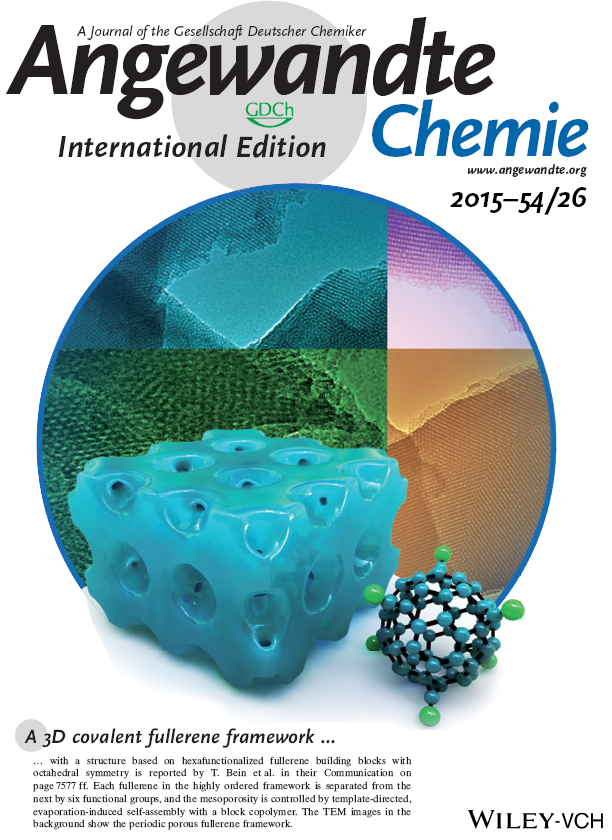
Our group’s collaborative work with Dr. Thomas Bein and co-workers at Ludwig Maximilians University Munich will be featured on the back cover of an upcoming issue of Angew. Chem. Int. Ed. The abstract is included here:
A 3D covalent fullerene framework with a structure based on hexafunctionalized fullerene building blocks with octahedral symmetry is reported by T. Bein et al. in their Communication on page 7577 ff. Each fullerene in the highly ordered framework is separated from the next by six functional groups, and the mesoporosity is controlled by template-directed, evaporation-induced self-assembly with a block copolymer. The TEM images in the background show the periodic porous fullerene framework.
Professor Ozin was invited to contribute a piece outlining his breakthrough Eureka moments in honor of the recently awarded 2015 RSC Centenary Award. The piece discusses his work in defining, enabling, and popularising a chemical approach to nanomaterials for innovative nanotechnology in advanced materials and biomedical science.
The full article can be found via the Materials Views website