A Whale of a Solution to Climate Change

Strategies to enhance the carbon capacity of the terrestrial and oceanic sinks tend to focus on landscapes – forest canopy, soil composition, and sea water chemistry. However, we must not neglect the role of animals in maintaining the natural carbon cycle. As it turns out, whales have the capacity to absorb enormous amounts of atmospheric carbon dioxide (CO2). Estimates place the carbon sequestering capacity of a whale to be similar to around 1000 trees with an average whale capturing up to 33 tons of CO2 over its 60-year lifetime, centuries. Efforts to re-establish whale populations, together with large scale reforestation, therefore offer a surprisingly impactful solution to meeting global emission targets.
See full article at Advanced Science News.

Posted in Uncategorized | Leave a comment

Congratulations to Hong Wang et al. on their publication in Advanced Science, “Heterostructure Engineering of a Reverse Water Gas Shift Photocatalyst”

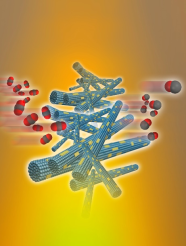
The paper describes a heterostructure engineering strategy that enables the gas-phase, photocatalytic, heterogeneous hydrogenation of CO2 to CO with high performance metrics. The catalyst is comprised of indium oxide nanocrystals (In2O3-x(OH)y) nucleated and grown on the surface of niobium pentoxide nanorods. Materials characterization demonstrates that the Nb2O5 support in the In2O3-x(OH)y@Nb2O5 heterostructure increases the number of oxygen vacancies and lengthens the excited state charge carrier lifetimes in the attached In2O3-x(OH)y nanocrystals, which results in a 44-fold higher conversion rate than pristine In2O3-x(OH)y selective conversion of CO2 to CO as well as long-term operational stability. Overall, the results of this study bode well for the general applicability of the heterostructure engineering approach for optimizing the performance of photocatalytic heterogeneous CO2 conversion reactions.
See full article at Advanced Science.

Posted in Uncategorized | Leave a comment

SF6 Worries – The Most Potent and Persistent Greenhouse Gas

It is not well known, but the most potent greenhouse gas is, surprisingly, neither carbon dioxide nor methane, but a colorless, odorless, and inert gas known as sulfur hexafluoride (SF6). With a global warming potential 23,900 times that of CO2 and being synthetic in nature (it is not absorbed on destroyed naturally), rising SF>6 concentrations are of major concern. Currently, electrical utilities and equipment are responsible for consuming 80% of the 10 000 tons of SF6 produced every year, an amount which is growing with the increasing global production and demand for renewable forms of energy, such as wind and solar. Can chemists and engineers rise to the challenge of solving the looming SF6 problem?

See full article at Advanced Science News.
Posted in Uncategorized | Leave a comment

Congratulations to Young and co-authors on their article in JACS

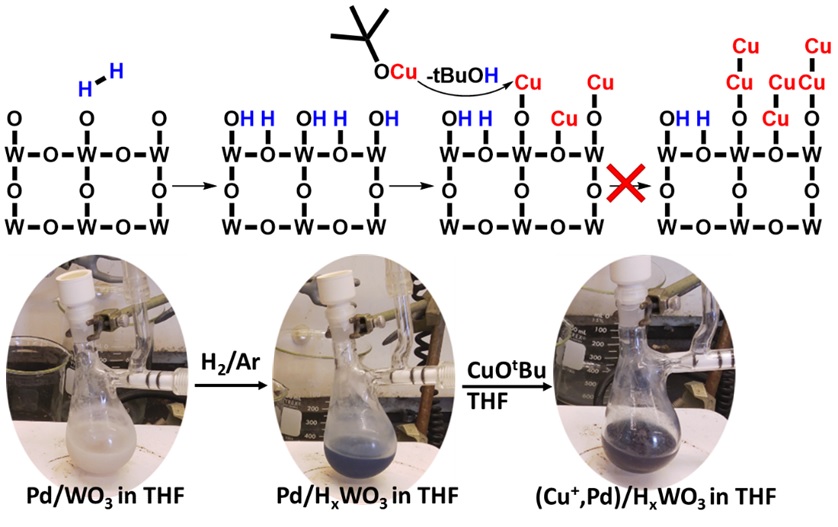
Atomically precise heterostrucutures present chemically interesting active sites for catalysis but are often expensive and/or challenging to synthesize. In this article, we report a synthetic strategy to conformally coating Cu atoms onto the surface of Pd/HyWO3-x by anchoring Cu(I)OtBu to the Brønsted acidic protons of the bronze. It was observed that just 0.2 at.% of Cu was able to increase the catalytic performance of CO2 hydrogenation to CO by 500%. This metal anchoring method enables atom precise modification of the surfaces of metal oxide nanomaterials for catalytic applications, circumventing the need for complex and expensive atomic layer deposition processes.

See full article at Journal of the American Chemical Society.

Posted in Uncategorized | Leave a comment

Congratulations to Lili Wan, Wei Sun, & co-authors on their article in Nature Catalysis

A long-standing challenge in the field of CO2 utilization is how to stabilize Cu2O, an earth-abundant, non-toxic, low-cost (photo)catalyst that can facilitate reduction of CO2 to CO against the irreversible redox disproportionation Cu2O → Cu + CuO, responsible for its instability.

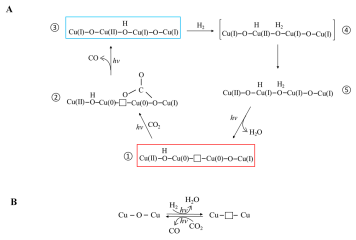
Lili Wan and Wei Sun and coworkers in the Ozin group have solved this problem as reported in their Nature Catalysis paper, by modifying the surface of Cu2O nanocubes with a mixed valence surface frustrated Lewis pair (SFLP), Cu(I,II) ●● OH, which serves to eliminate the redox disproportionation. As depicted in the illustration, H2 undergoes heterolytic dissociation on the SFLP, water is eliminated to create an [O] vacancy and Cu(I) is reduced to Cu(0). Adsorption of CO2 at the [O] vacancy site drives the conversion to CO thereby completing the photocatalytic RWGS reaction cycle

See full article at Nature Catalysis.

Posted in Uncategorized | Leave a comment

Congratulations to Dr. Zaiyong Jiang et al. on their paper, “Building a Bridge from Papermaking to Solar Fuels

Everybody knows the leaf makes carbohydrates and the trunk makes paper. But did you know that waste from the paper making process can make fuel from carbon dioxide, water and sunlight? Black liquor, an industrial waste product of papermaking, is primarily used as a low‐grade combustible energy source. Despite its high lignin content, the potential utility of black liquor as a feedstock in products manufacturing, remains to be exploited. In this paper, black liquor is demonstrated to function as a primary feed‐stock for synthesizing graphene quantum dots that exhibit both up‐conversion and photoluminescence when excited using visible/near‐infrared radiation, enabling solar‐powered generation of H2 from H2O, and CO from H2O–CO2, using broadband solar radiation.

See full article at Angewandte Chemie.

Posted in Uncategorized | Leave a comment

Congratulations to Zaiyong Jiang, Wei Sun, & co-authors on their article in Advanced Science

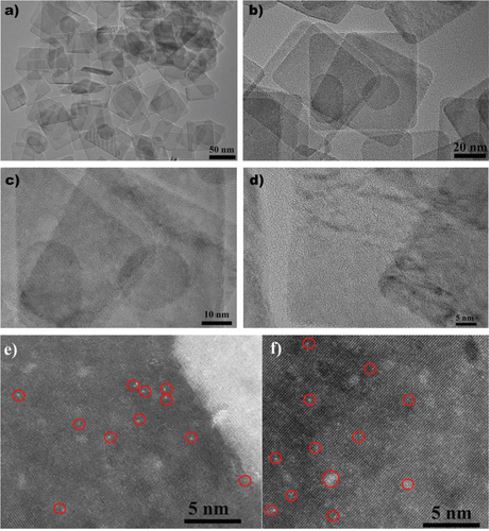
In their paper, “Living Atomically Dispersed Cu Ultrathin TiO2 Nanosheet CO2 Reduction Photocatalyst”, Jiang, Sun, and co-authors report a serendipitous living photodeposition method can make atomically dispersed Cu immobilized on ultrathin TiO2 nanosheets, which can photocatalytically reduce an aqueous solution of CO2 to CO and in the process can be recycled in a straightforward procedure on becoming oxidatively deactivated.

See full article at Advanced Science.

Posted in Uncategorized | Leave a comment

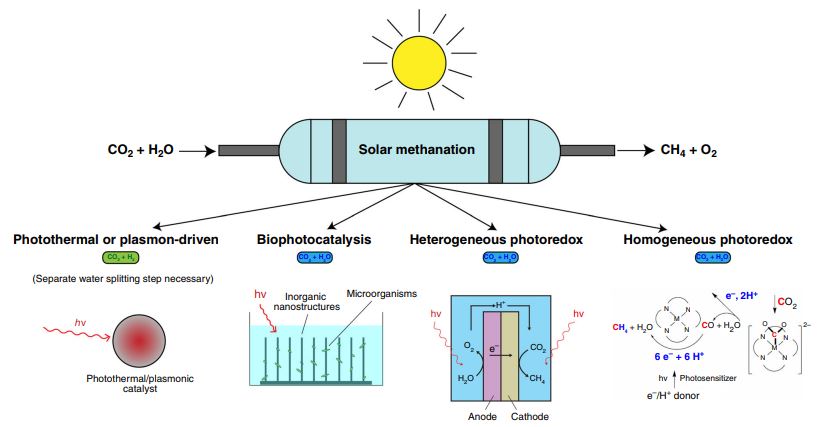
Fundamentals and Applications of Photocatalytic CO2 Methanation

The extraction and combustion of fossil natural gas, consisting primarily of methane, generates vast amounts of greenhouse gases that contribute to climate change. However, as a result of recent research efforts, “solar methane” can now be produced through the photo-catalytic conversion of carbon dioxide and water to methane and oxygen. This approach could play an integral role in realizing a sustainable energy economy by closing the carbon cycle and enabling the efficient storage and transportation of intermittent solar energy within the chemical bonds of methane molecules. In this article, Uli and co-authors explore the latest research and development activities involving the light-assisted conversion of carbon dioxide to methane.
See full article at Nature Communications.

Posted in Uncategorized | Leave a comment

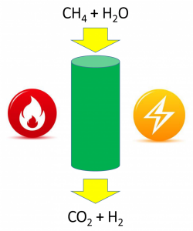
Challenges of Electrifying Heterogeneous Catalysis

How can we replace the fossil-fuel-derived heat that conventionally drives chemical processes with an emissions-free alternative? The current standard in industrial-scale heterogeneous catalytic processes, such as the production of ammonia and hydrogen, is to use heat supplied by the combustion of natural gas. Heat can alternatively be supplied from non-fossil sources, such as renewable electricity; however, assessing the net impact on carbon emissions of electricity-based processes remains non-trivial.
See full article at Advanced Science News.
Posted in Uncategorized | Leave a comment

Electrochemical Carbon Dioxide Reduction in Supercritical Carbon Dioxide is Cool

At standard temperature and pressure, CO2 exists as a gas. On cooling to -78.5 °C, it becomes a solid called dry ice, which is a common refrigerant. At a critical temperature of 31.1 °C and pressure 72.9 atmospheres, however, CO2 becomes a supercritical fluid with properties intermediate to a gas and liquid. In this form, CO2 fills a containment vessel and exhibits a low viscosity reminiscent of a gas but retains the high density of a liquid. It turns out that supercritical CO2 also has rather appealing properties as both solvent and reagent in the electrochemical reduction of CO2 to a variety of products.
See full article at Advanced Science News.

Posted in Uncategorized | Leave a comment